

 +44 2392 006926
 Back to Blog page


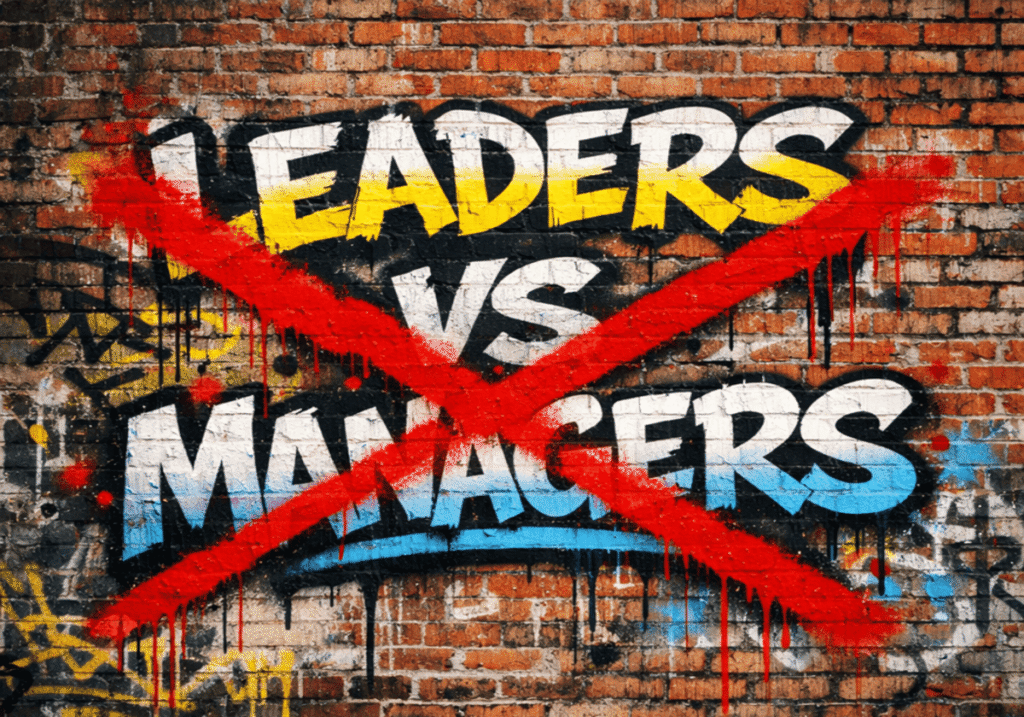
It really is time to end the discussion on leaders versus managers that still pops up on Linked In from time to time. The fundamental truth is that nearly all managers need to practise both leadership and management in order to be effective.
By definition, this means he or she needs to be both a leader as well as a manager!
Confusion arises because many writers either compare competent and incompetent managers (which I’ll explain shortly) or suggest that leadership is the domain of only senior managers who set the direction, while those below them simply carry it out.
The problem with this is that most managers, even when getting some direction from their seniors, also set their own direction to a significant degree. Secondly, leadership consists of far more than just setting the direction!
A large part of my frustration with this discussion stems from how often it paints an unfairly negative picture of managers. For example, if you did a quick internet search on leaders versus managers, you will usually come across statements like these:
- Leaders give the credit, managers take the credit.
- Leaders are proactive, managers are reactive.
- Leaders break rules, managers make rules.
- Leaders inspire, managers demotivate.
- Leaders are passionate, managers are controlling.
- People follow leaders because they want to. They follow managers because they have to.
As I mentioned above, none of these comparisons are actually discussing leaders versus managers – instead they simply contrast effective managers with ineffective ones.
Here’s the reality. Once a manager has one person or more reporting to them then they have to practice leadership. They need to be able to influence their employee/s to achieve goals and get results. The word ‘influence’ is a packed word, and a lot of leadership training focuses on ways of helping managers (as leaders) to develop the competencies needed in order to influence employees to higher levels of performance. This includes coaching, communicating, motivating, delegating and much more.
Equally, if a manager has also been given some resources to use effectively to achieve goals and get results, then they have to practice management – or what I call ‘pure management’ (as the term ‘Management’ should include both leadership and pure management in terms of covering what managers actually do). Pure management requires competencies such as planning, organising, prioritising and problem solving.
This explains why nearly all managers have to practice both to be effective.
One last thing.
During this discussion you will often hear this quote trotted out:
“Leaders do the right things, managers do things right.”
The implication is that senior leaders decide what to do, and managers merely execute it.
Again, this is nonsense. Most managers are making both daily and weekly decisions about what needs to be done, with only a partial input from their seniors.
In fact, when you understand this quote you will recognise that actually all employees need to be doing the right things because this is about being effective at your job through good planning and prioritising.
Equally they also have to do those things right, because this means doing jobs efficiently through having the correct knowledge and skills needed to do them.
Everyone in an organisation should therefore be doing both…..ideally!
So, let’s discard that quote as well.
Debating leaders versus managers is a waste of time, and if you are still doing it, you haven’t yet grasped the fundamentals of either.
If you would like to hear more on this, I would be happy to share at your next conference or deliver a training programme that can make this absolutely clear for all your managers or attendees.